All Categories
Featured
Table of Contents
Risks are tilted to the disadvantage. In case of an extended conflict, the existing effect on the region will be compoundedthrough raised energy and food costs, decreasing trade, tourist and remittances, increased financial pressures, and displacement. "The existing crisis is a stark tip of the work ahead for the area: not just to weather shocks, however to restore more durable economies with stronger macroeconomic basics, innovate and enhance governance, invest in facilities, and improve employment-creating sectors," said.
With peace and the right action, countries can build the institutions, abilities and competitive sectors that develop chances for people." With this long-lasting vision in mind, the report takes a close appearance at the region's capacity for commercial policy federal government actions to increase tactical service activity as a chauffeur of financial growth and job creation.
Governments in the area have actually embraced industrial policy at a high rate in the last decade, frequently through sovereign wealth funds and state-owned business, however the outcomes have been mixed. The report highlights the vital requirement for strong organizations and cautious targeting of policies. "As countries face the heavy toll of today conflict, it is necessary to also not forget the work needed for lasting peace and success," said.
Why Industrial Diversification Can Shape Arabian Markets
Q2 2026: The ICAEW Economic Update Middle East, is a quarterly economic forecast for the region prepared directly for the finance profession. The GCC economy deals with a significant contraction this year pending details of the US-Iran contract to end the war. We expect energy flows, tourism and financier belief to slowly normalise as war interruptions decrease.
The interim agreement between the United States and Iran is a considerable action towards reaching a full-blown deal. A full return to normality in the Strait of Hormuz will likely take some time, however the danger of a recession-inducing oil price spike has actually declined. International GDP is anticipated to grow by 2.4% this year, 0.2 ppt less than we projected three months ago, and 3.1% in 2027.
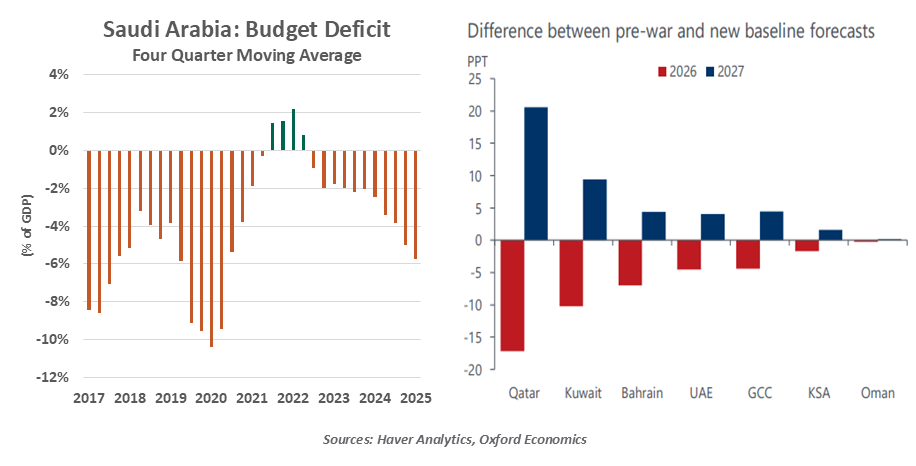
We anticipate a 4.1% contraction in Middle East GDP this year (versus predicted 3.6% expansion before the war), greater than the decrease in the very first year of the Covid pandemic. Kuwait, Iran, Iraq and Qatar stick out as the hardest hit, owing to their failure to prevent the interruption to local shipping, war-driven facilities damage and tourist losses.
Our 2026 outlook for the GCC is weaker than 3 months earlier, with GDP forecast to agreement by 2.4% compared to a 0.2% decrease forecasted previously. We anticipate Oman and Saudi Arabia to be the least adversely impacted by the fallout from the conflict, with both economies continuing to broaden this year.
The economic damage sustained in the last couple of months is substantial. Saudi GDP information for Q1 showed growth slowed to 3% y/y, with non-oil activities expanding by 2.9%, the weakest pace because the Covid pandemic. On a seasonally adjusted basis, GDP contracted 1.2% q/q, driven by a 6.8% fall in oil activities as the Strait of Hormuz disturbance struck late in the quarter.
Accelerating Non-Oil Success via Strategic Diversification
Aside from Oman, all GCC manufacturers as well as Iran and Iraq have actually suffered substantial oil and gas production losses given that the start of the conflict. May data show local production almost halved from pre-war levels, with the decline deepening relative to March and April. Rerouting efforts, consisting of by Saudi Arabia through the East-West Pipeline and the UAE through the Habshan-Fujairah pipeline, have actually assisted avoid an even bigger plunge in output.
We forecast GCC oil sector output to contract by 14.5% this year, which will mark the steepest decline in several years. We then anticipate a 23.5% rebound next year, driven mainly by normalisation from a seriously depressed base. Oil prices have actually been unstable, reducing below $85 per barrel as the interim agreement was announced.
In the medium term, we anticipate oil costs to be slightly lower than our pre-war standard, as the UAE's departure from OPEC+ allows for a progressive boost in its output towards the 5mn barrel per day production target once trade normalises. Against this background, the UAE will speed up the building and construction of a brand-new West-East pipeline that ought to double the capability of export through Fujairah.
The May PMI surveys reported output growth reaching its greatest level in 3 months, driven mostly by improved domestic demand. However, they stay below long-run averages, with weak export orders and price pressures from greater product and transport expenses are a typical theme. Overall, we expect a 1.1% contraction in GCC non-energy sectors this year (compared to 4.2% growth pre-war) and a gradual recovery over the remainder of the decade.

Latest Posts
Why Economic Diversification Can Shape Arabian Markets
Roadmap to Gulf Stock Equity Trends in 2026
Future-Proofing Regional Portfolios for 2026 Shifts